Local Rules
Penalty for Breach of a Local Rule:
General Penalty unless otherwise stated
A-1 Out of Bounds (Rule 18.2 / Definition Out of Bounds)
Defined by stakes with white tops or white markings on fences;
The terrace, clubhouse, car park, and all areas beyond are out of bounds.
B. Penalty Areas (Rule 17 / Definition Penalty Area)
B-1 The following penalty areas extend to infinity:
- Left of hole 2 in a southerly direction
- Left of hole 7 in a northerly direction
- Only when playing hole 9: Left of hole 9 in a northerly direction
- Right of hole 10 in a southerly direction
- Right of hole 12 in an easterly direction
- Right of holes 13 and 14 in a northerly direction
- Right of hole 18 in a southerly direction
C. Bunkers (Rule 12 / Definition Bunker)
C-1. Clarification of the boundary of the bunker on hole 13 (Rule 12)
The raked sand area to the right of hole 13 is considered part of the bunker. The unraked sandy area on this hole is part of the general area and not a bunker.
E. Special or Mandatory Relief Procedures
E-4 Relief from Aeration Holes
If a player’s ball lies in or against an aeration hole:
Ball in the general area: The player MAY take relief under Rule 16.1b. If the ball comes to rest in another aeration hole, the player may again take relief under this Local Rule.
Ball on the putting green: The player MAY take relief under Rule 16.1d.
There is, however, no relief if the aeration hole only interferes with the player’s stance, or—on the putting green—with the player’s line of play.
Penalty for Playing Ball from a Wrong Place in Breach of a Temporary Local Rule:
General Penalty under Rule 14.7a
E-10 Protection of Young Trees (Rule 16.1)
Young trees identified by blue stakes, blue ribbons, or by being staked, are No Play Zones.
If a player’s ball lies anywhere on the course except in a penalty area, and it touches such a tree or the tree interferes with the player’s stance or intended swing, the player MUST take relief under Rule 16.1f.
If the ball lies in a penalty area and such a tree interferes with the stance or intended swing, the player MUST either:
– take penalty relief under Rule 17.1e(1), or
– take free relief under Rule 17.1e(2).
Penalty for Playing Ball from a Wrong Place in Breach of a Local Rule:
General Penalty under Rule 14.7a
F. Abnormal Course Conditions and Integral Objects
F-1 Ground Under Repair (Rule 16.1 / Definition Ground Under Repair)
Ground Under Repair (GUR) is defined by any area encircled by a blue line (or blue stakes or ribbons); such areas MUST be treated as abnormal course conditions and relief is mandatory under Rule 16.1.
F-5 Immovable Obstructions Close to Putting Green
Relief from interference by an immovable obstruction may be taken under Rule 16.1.
In addition, the player has an extra option to take relief when such an obstruction is on the line of play and is:
- within two club-lengths of the putting green; and
- within two club-lengths of the ball.
Exception: Relief is not allowed if the line of play is clearly unreasonable. Relief under this Local Rule is not permitted if the player chooses a clearly unreasonable line of play.
Penalty for Playing Ball from a Wrong Place in Breach of a Local Rule:
General Penalty under Rule 14.7a
E. Additional Special Relief Procedure
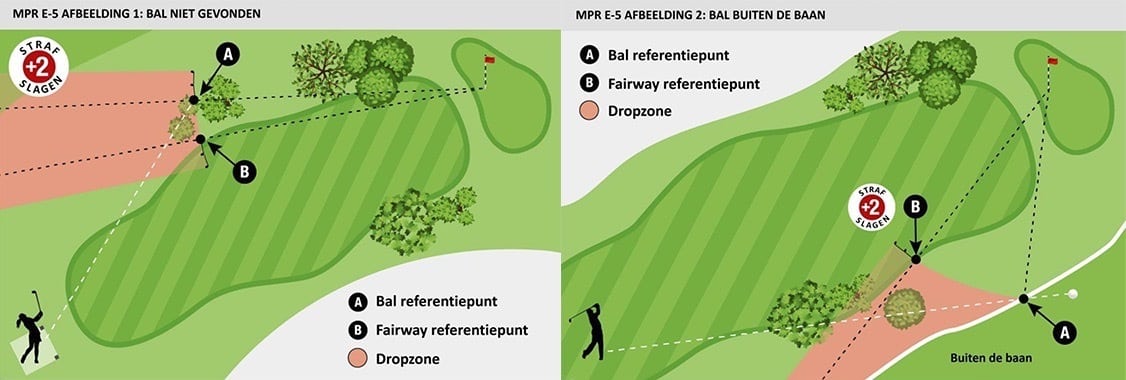
E-5 Alternative to Stroke and Distance for Ball Lost or Out of Bounds
If a player’s ball has not been found, or it is known or virtually certain that it is out of bounds, the player may proceed as follows instead of taking stroke-and-distance relief:
With a penalty of two strokes, the player may drop the original ball or another ball in a relief area defined as follows (see Rule 14.3):
Two estimated reference points are required:
- Ball Reference Point: The point where the original ball is estimated to have:
- come to rest on the course, or
- last crossed the edge of the course boundary to go out of bounds.
- Fairway Reference Point: The point on the fairway of the hole being played that is nearest to the ball reference point, but not nearer the hole.
In this Local Rule, “fairway” means the general area cut to fairway height or less.
If the ball is estimated lost on the course or last crossed the boundary before reaching the fairway, the fairway reference point may be a closely mown path or teeing area of the hole being played.
The size of the relief area is based on reference points, defined as the area between:
- a line from the hole through the ball reference point (and within two club-lengths to the outside of that line), and
- a line from the hole through the fairway reference point (and within two club-lengths to the fairway side of that line), with the following limits:
Limits of the Relief Area:
- must be in the general area, and
- must not be nearer the hole than the ball reference point.
Once the player puts a ball into play under this Local Rule:
- The original ball is no longer in play and must not be played.
- This remains true even if the original ball is found on the course within the three-minute search time (see Rule 6.3b).
This Local Rule does not apply to the original ball if:
- it is known or virtually certain that the ball came to rest in a penalty area, or
- the player has played a provisional ball under stroke-and-distance penalty (see Rule 18.3).
However, this Local Rule may be applied to a provisional ball that is not found or is known or virtually certain to be out of bounds.
Penalty for Playing Ball from a Wrong Place in Breach of this Local Rule:
General Penalty under Rule 14.7a
Rules refer to the “Rules of Golf, effective January 2023” (R&A/USGA)
During designated periods, artificial tee mats are in use on all par-3 holes, positioned within 10 metres of the tee markers; the use of these mats when starting a hole is mandatory and permitted in accordance with the Rules of Golf as approved by the R&A, and does not affect the qualifying status of the course.